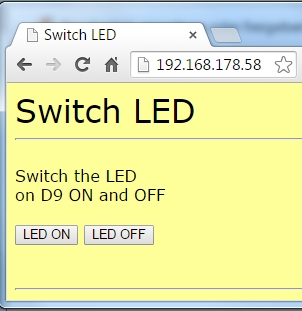
Day 13: Website with buttons

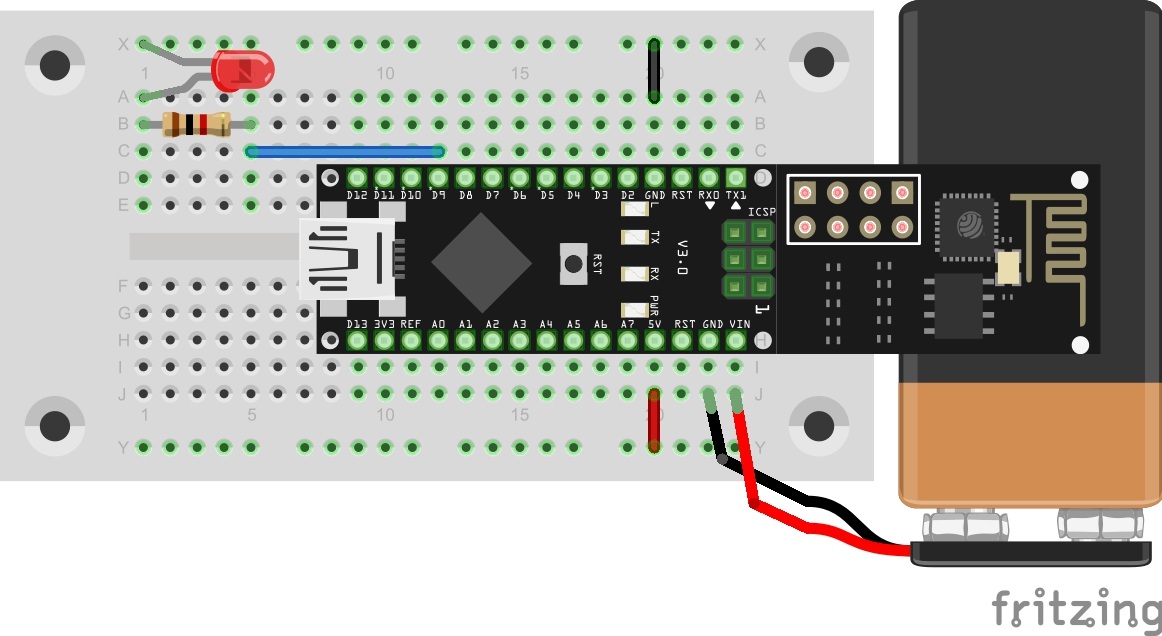
In today’s experiment, the illustration of the website is even more sophisticated. There are now also control elements that permit much more comfortable control of the LED. The 9V-batterie powers the board The structure of today’s experiment is no different from yesterday’s: An LED at pin D9, which can be controlled via the module. As an additional component, today’s door once again holds a resistor with 1 kΩ. If necessary, you can now reduce the brightness of an LED by switching two resistors in series. ...
13.12.2015 · 1 min · Fabian Kainka

Day 12: Autonomous webserver

The results of yesterday’s experiment are now to be used in an autonomous program. Today’s program not only sends a simple website to the browser, but also permits control of an LED. The 9V-batterie powers the board Behind today’s door, you will find a 9-V battery clip that can make your board mobile. As an alternative, you may also use a Power Bank (a battery pack usually used for mobile phones). If you want to use the 9-V-battery, observe that the red wire must be connected to Vin, and the black one to GND. The figure shows the setup of today’s experiment with external power supply. ...

12.12.2015 · 1 min · Fabian Kainka

Day 11: TCP-Webserver

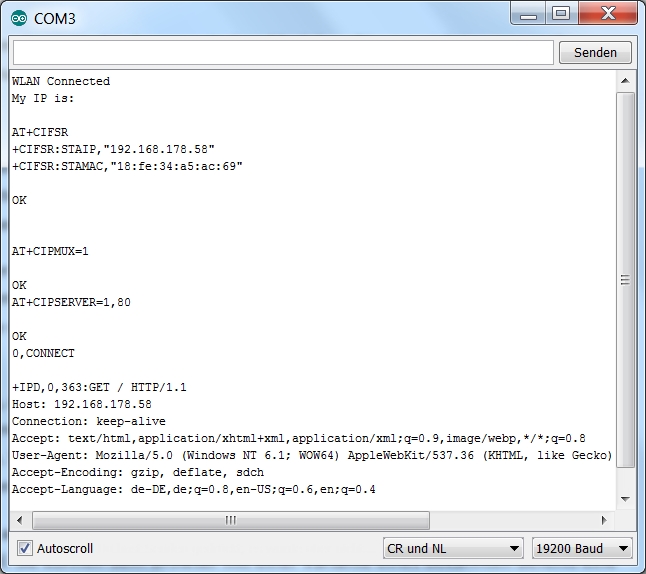
In the previous experiments, we dealt with the subject of TCP and access to web servers a lot. Today, the module is to act as a web server of its own for the first time. Behind the door of the 11th day, there is a special cable that will be very useful soon. A special setup is not necessary today, since the program works similarly to the serial monitor programme of day one. ...

11.12.2015 · 2 min · Fabian Kainka