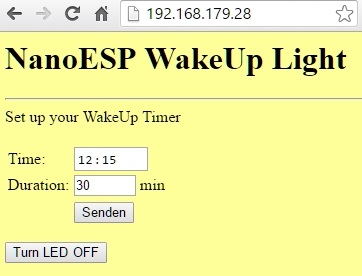
Today’s project deals with a well-known lamp from Phillips, the Wake Up Light. This is an alarm clock that, instead of making a loud noise, slowly increases the brightness. This creates a type of sunrise, and one wakes up in a natural manner.
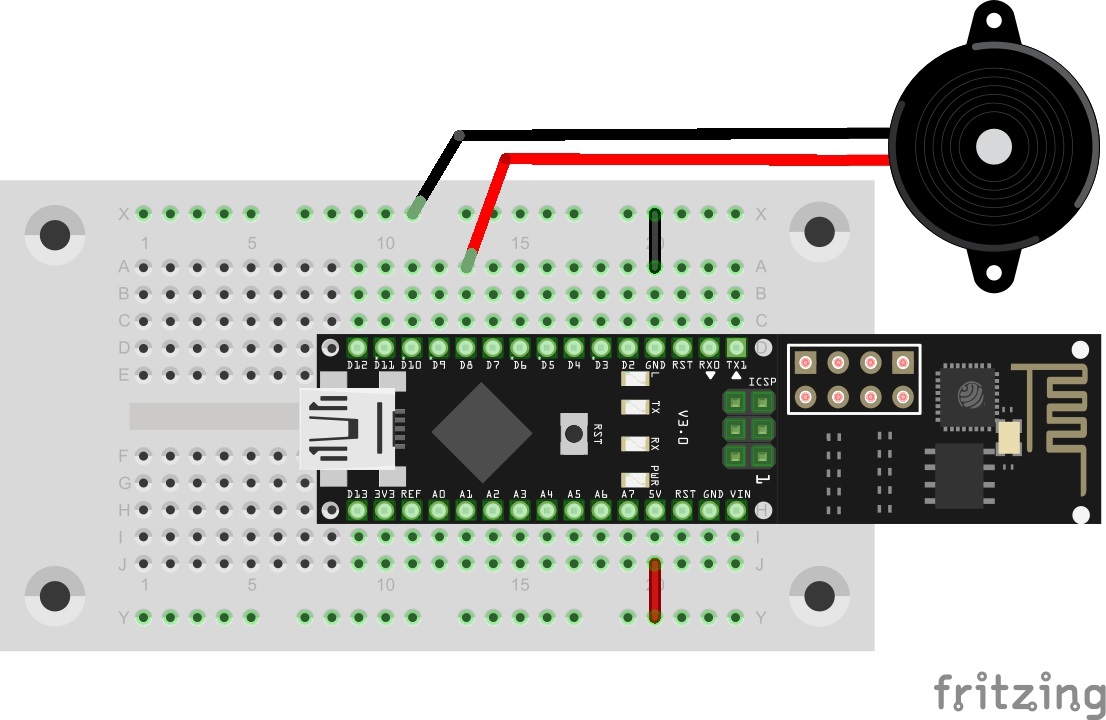
Behind today’s door is another potentiometer, which is important for tomorrow’s test. The following layout is required today:
The RGB LED with series resistors The sketch: A16_P17_WakeUpLight.ino /* TCP-Server: Wakeup light Change SSID and PASSWORD. RGB-Led (common cathode) on Pins 3,5,6 */ #include <NanoESP.h> #include <NanoESP_HTTP.h> #include <SoftwareSerial.h> #include "Websites.h" #include <math.h> #include <Time.h> #define SSID "YourSSID" #define PASSWORD "YourPassword" #define LED_WLAN 13 #define RED 3 #define GREEN 5 #define BLUE 6 #define GND 4 #define BUTTON 7 NanoESP nanoesp = NanoESP(); NanoESP_HTTP http = NanoESP_HTTP(nanoesp); //String timeServerIP = ; // time.nist.gov NTP server address String ntpServerName = "195.145.119.188";//"time.nist.gov"; const int NTP_PACKET_SIZE = 48; // NTP time stamp is in the first 48 bytes of the message byte packetBuffer[NTP_PACKET_SIZE]; //buffer to hold incoming and outgoing packets int alarmHour = 0, alarmMinute = 2; bool alarm; byte cRed = 0, cBlue = 0, cGreen = 0; unsigned long previousMillis = 0; // will store last time a msg was send unsigned long interval = 78; // void setup() { Serial.begin(19200); nanoesp.init(); pinMode(RED, OUTPUT); pinMode(GREEN, OUTPUT); pinMode(BLUE, OUTPUT); pinMode(GND, OUTPUT); digitalWrite(GND, LOW); pinMode(BUTTON, INPUT); //Only Station Mode for TimeSync nanoesp.configWifiMode(STATION); //delay(1000); // Wait till Connected to WiFi if (nanoesp.wifiConnected())digitalWrite(LED_WLAN, HIGH); else Serial.println(F("Error WLAN Connect")); //Start TCP Server if (nanoesp.startTcpServer(80)) Serial.println(F("TCP Server Activ")); else Serial.println(F("TCP Server Error")); //Print IP in Terminal Serial.println(nanoesp.getIp()); setSyncProvider(getNtpTime); Show_Time(); } time_t getNtpTime() { //convert to time_t , Paramter: connectionId, ServerAdress, Timezone return (time_t)getNTPpacket(4, ntpServerName, 2); } void loop() { String method, ressource, parameter; int id ; if (http.recvRequest(id, method, ressource, parameter)) { Serial.println("New Request from id :" + String(id) + ", method: " + method + ", ressource: " + ressource + " parameter: " + parameter); if (ressource == "/") { http.sendFromFlash(id, index, sizeof(index)); nanoesp.closeConnection(id); } if (ressource == "/settimer") { if (parameter != "") { //timer=02%3A03& String sHour = parameter.substring(parameter.indexOf('=') + 1, parameter.indexOf('%')); String sMin = parameter.substring(parameter.indexOf('A') + 1, parameter.indexOf('&')); String sDuration = parameter.substring(parameter.indexOf('&') + 1); sDuration = sDuration.substring(sDuration.indexOf('=') + 1, sDuration.indexOf('&')); alarmHour = sHour.toInt(); alarmMinute = sMin.toInt(); int iDuration = sDuration.toInt(); interval *= iDuration; Serial.println("Timer: " + String(alarmHour) + ":" + String(alarmMinute) + " Duartion: " + String (iDuration) ); Show_Time(); } nanoesp.closeConnection(id); } if (ressource == "/turnoff") { alarm = false; cRed = 0; cBlue = 0; cGreen =0; analogWrite(RED,cRed); analogWrite(BLUE,cBlue);analogWrite(GREEN,cGreen); } else { http.sendFromFlash(id, error404, sizeof(error404)); nanoesp.closeConnection(id); } } else { if (hour() == alarmHour) { if (minute() == alarmMinute) { if (!alarm) alarm = true; } } if (alarm) wakeUp(); } } void MorningAlarm() { Serial.println("Alarm: - turn lights off"); } void wakeUp() { if (millis() - previousMillis >= interval) { previousMillis = millis(); if (cRed == 0) Show_Time(); if (cRed < 255) { cRed++; analogWrite(RED, cRed ); } else { if (cGreen < 255) { cGreen++; analogWrite(GREEN, cGreen); } else { if (cBlue < 255) { cBlue++; analogWrite(BLUE, cBlue ); if (cBlue == 255) Show_Time(); } } } } } // prepare an NTP request to the time server and send to the given bool sendNTPpacket(int id, String address) { // set all bytes in the buffer to 0 memset(packetBuffer, 0, NTP_PACKET_SIZE); // Initialize values needed to form NTP request // (see URL above for details on the packets) packetBuffer[0] = 0b11100011; // LI, Version, Mode packetBuffer[1] = 0; // Stratum, or type of clock packetBuffer[2] = 6; // Polling Interval packetBuffer[3] = 0xEC; // Peer Clock Precision // 8 bytes of zero for Root Delay & Root Dispersion packetBuffer[12] = 49; packetBuffer[13] = 0x4E; packetBuffer[14] = 49; packetBuffer[15] = 52; // // if we need a cr/lf // packetBuffer[NTP_PACKET_SIZE ] = 0x0D; packetBuffer[NTP_PACKET_SIZE + 1] = 0x0A; // all NTP fields have been given values, now // you can send a packet requesting a timestamp: if ( nanoesp.sendRaw(id, packetBuffer, NTP_PACKET_SIZE)) return true; return false; } long getNTPpacket(int id, String address, int timeZone) { unsigned long secsSince1900; byte offset = 40; if (!nanoesp.newConnection(id, UDP, address, 123)) Serial.println ("no connection ntp server"); //NTP requests are to port 123 delay(100); if (!sendNTPpacket(id, address)) { Serial.println("No time request send"); return 0; } nanoesp.setTimeout(2000); if (nanoesp.find("+IPD,")) { int vid = nanoesp.parseInt(); nanoesp.find(","); int len = nanoesp.parseInt(); //Serial.println(String(len)); byte buffer[len]; nanoesp.find(":"); nanoesp.readBytes(buffer, 48); // for (int i = 0; i <= NTP_PACKET_SIZE; i++) { // Serial.print(buffer[i], HEX); // } // convert four bytes starting at location 40 to a long integer secsSince1900 = (unsigned long)buffer[offset + 0] << 24; secsSince1900 |= (unsigned long)buffer[offset + 1] << 16; secsSince1900 |= (unsigned long)buffer[offset + 2] << 8; secsSince1900 |= (unsigned long)buffer[offset + 3]; nanoesp.find("OK\r\n"); nanoesp.closeConnection(id); // return secsSince1900 + timeZone * SECS_PER_HOUR; // NTP Date return secsSince1900 - 2208988800UL + timeZone * SECS_PER_HOUR; // UNIX Date } else { Serial.println("no time recieved"); nanoesp.closeConnection(id); return 0; } } void Show_Time() { String shour, sminute, ssecond; Serial.print("Date: "); Serial.print(day()); Serial.print("."); Serial.print(month()); Serial.print("."); Serial.println(year()); if (hour() <= 9) shour = "0" + String(hour()); else shour = String(hour()); // adjust for 0-9 if (minute() <= 9) sminute = "0" + String(minute()); else sminute = String(minute()); if (second() <= 9) ssecond = "0" + String(second()); else ssecond = String(second()); Serial.println( "Time: " + shour + ":" + sminute + ":" + ssecond ); } (The former Arduino Create embed is no longer available; the code is taken from the download of all sketches.)
...